
Holding the Line for Oregon’s Public Forests
last updated January 28, 2026

Crag attorney Brenna Bell and our clients visit the proposed 42 Divide project site. Photo by Madeleine Cowen, Cascadia Wildlands.
Crag files new case challenging unlawful logging in SW Oregon forests
New case! On January 21, 2026, we filed a new federal lawsuit to stop a large, unlawful logging project on public lands in southwest Oregon—and to protect forests, wildlife, and nearby communities from serious harm. We’re proud to work with our clients Cascadia Wildlands, Oregon Wild, and Umpqua Watershed in this critical forest defense case.
The case challenges the Bureau of Land Management (BLM)’s “42 Divide Forest Management Plan,” a proposal to aggressively log nearly 7,000 acres of public forest near Camas Valley in Douglas County. Much of the targeted land lies within conservation reserves that are supposed to protect older forests and imperiled wildlife—not be cut down for commercial logging.

Photo by Francis Eatherington.

Preserving older, complex forest areas ensures that threatened species have places to nest, feed, and thrive. Photo by Madeleine Cowen, Cascadia Wildlands.
Why the BLM’s 42 Divide Logging Project sets dangerous precedent
The 42 Divide project authorizes thousands of acres of commercial logging in protected reserves that currently provide high quality habitat for the threatened northern spotted owl and marbled murrelet, despite the BLM’s management plan requiring BLM to “protect” such forests by prohibiting timber harvesting activities.
These public forests are home to federally protected northern spotted owls, marbled murrelets, Oregon Coast coho salmon, and BLM-designated sensitive species like western pond turtles. They also include vibrant forest areas of Douglas fir, cedar, and madrone, supporting a rich web of plant, animal, and fungal life.


Photos of northern spotted owlets, northwestern pond turtles, and marbled murrelets by USFWS-PNW, Don Henise, CC BY 2.0, and Eric Ellingson, CC BY-NC-ND 2.0.
BLM claims the project is about “restoration” and “resilience.” But the agency’s own analysis acknowledges that the logging would leave behind hundreds of tons of logging slash (branches, treetops, and debris) — which actually makes forests more flammable and would increase wildfire hazard around nearby rural communities.
Logging removes large, fire-resistant trees and opens the forest canopy, making forests hotter, drier, and windier. It also stimulates the growth of hazardous surface and ladder fuels. Far from protecting communities, this kind of logging can make fire behavior more extreme for decades.
Why we’re bringing this to court
We filed this lawsuit to stop the BLM from evading the law and ignoring the explicit protections in its own Resource Management Plan. The lawsuit alleges that the 42 Divide project violates federal environmental laws and agency regulations by:
-
- Failing to protect older forest stands in Late Successional Reserves, which are meant to safeguard the highest-value spotted owl habitat
- Downplaying or omitting analysis of impacts to wildlife, waterways, and forest structure
- Wrongly concluding that the project would not significantly harm the environment
Time and again, the BLM has wrapped large logging projects targeting mature and old forests in the language of “restoration”—despite clear science showing increased fire risk and harm to protected species. This case asks the court to draw a line and require the agency to follow its own rules.
What’s at Stake
If we win, thousands of acres of mature and older forest could remain standing, protecting wildlife habitat and preventing an unnecessary increase in wildfire danger for surrounding rural communities.

Healthy forests provide clean water and climate resilience: Standing, mature forests help clean the air, store carbon, cool streams, prevent erosion, and maintain water quality. They also support climate resilience, helping the forest recover from drought, storms, and other disturbances.

Protecting wildlife habitat: These forests are home to threatened species like northern spotted owls, marbled murrelets, Oregon Coast coho salmon, and western pond turtles, as well as countless other plants, fungi, and animals. Preserving older, complex forest areas ensures that these species continue to have places to nest, feed, and thrive, keeping Oregon’s biodiversity intact.

Reducing wildfire risk for communities: Logging removes large, fire-resistant trees and leaves behind debris called “slash”—branches, tree tops, and other leftover material that can fuel wildfires. Standing forests with mature trees and intact canopies are naturally less flammable, providing a buffer that protects nearby rural communities from more extreme fire behavior. Preserving these forests can prevent dangerous, unnecessary wildfire risks for decades.
Photos of Oregon coho salmon, chicken of the woods mushrooms, and slash produced by logging by K. King/USFWS, Peter Pearsall/USFWS, and Kelsey Furman/KS Wild.
Looking Ahead
For 25 years, Crag has worked to restore thriving ecosystems and hold public land managers accountable. A major focus of that work has been holding the BLM accountable to following its own rules when managing public forests.
This lawsuit carries that legacy forward—and sends a clear message:
Thriving forests are essential, and worth defending. The law matters. And when the federal government refuses to follow it, Crag will be there to hold the line.
As the case unfolds, we’ll continue to share updates and amplify information from our clients and partners on the ground.
Our Clients
We’re proud to work with our clients Cascadia Wildlands, Oregon Wild, and Umpqua Watershed in this critical forest defense case.
-
- Cascadia Wildlands defends and restores Cascadia’s wild ecosystems in the forests, in the courts, and in the streets.
- Oregon Wild is Oregon’s oldest statewide environmental nonprofit working to protect wildlands, wildlife, and waters for generations to come.
- Umpqua Watersheds has been dedicated to the protection and restoration of the Umpqua Watershed and beyond through education, training & advocacy since 1995.
Resources
Want to learn more? Here are some additional resources:
-
- Cascadia Wild’s Jan 21, 2026 Press Release, “Conservation Groups Challenge Feds’ Illegal 42 Divide Logging Plan in Western Oregon”
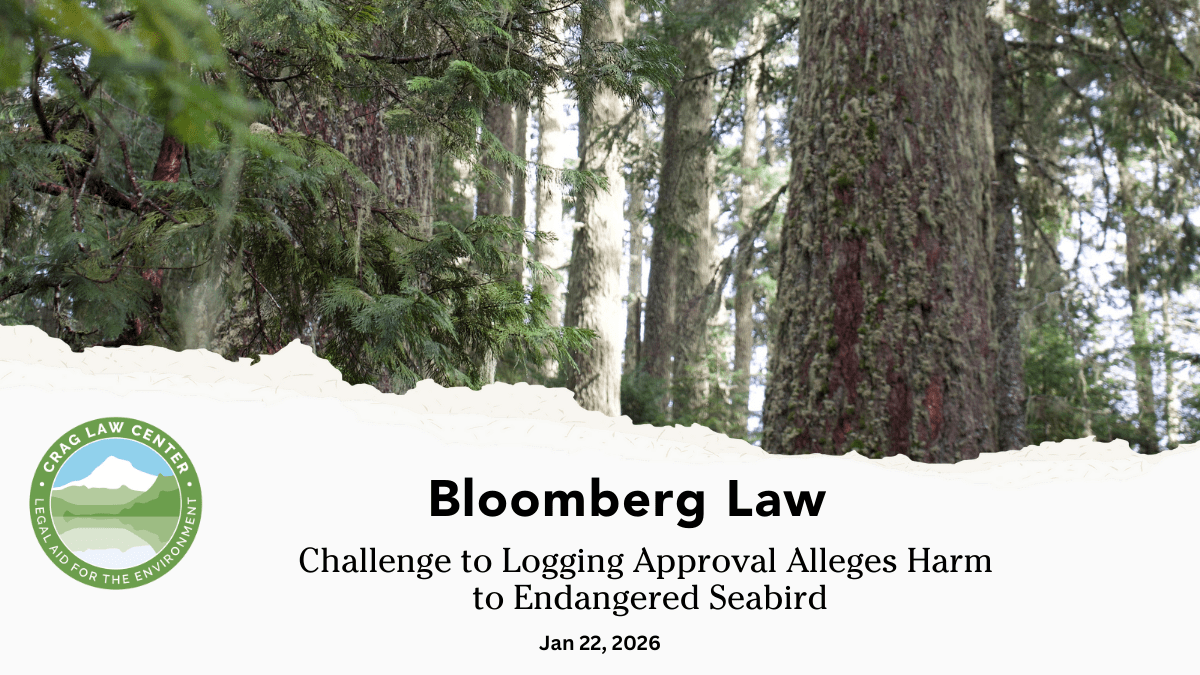
- Bloomberg Law, Jan 22, 2026 Article, “Challenge to Logging Approval Alleges Harm to Endangered Seabird”